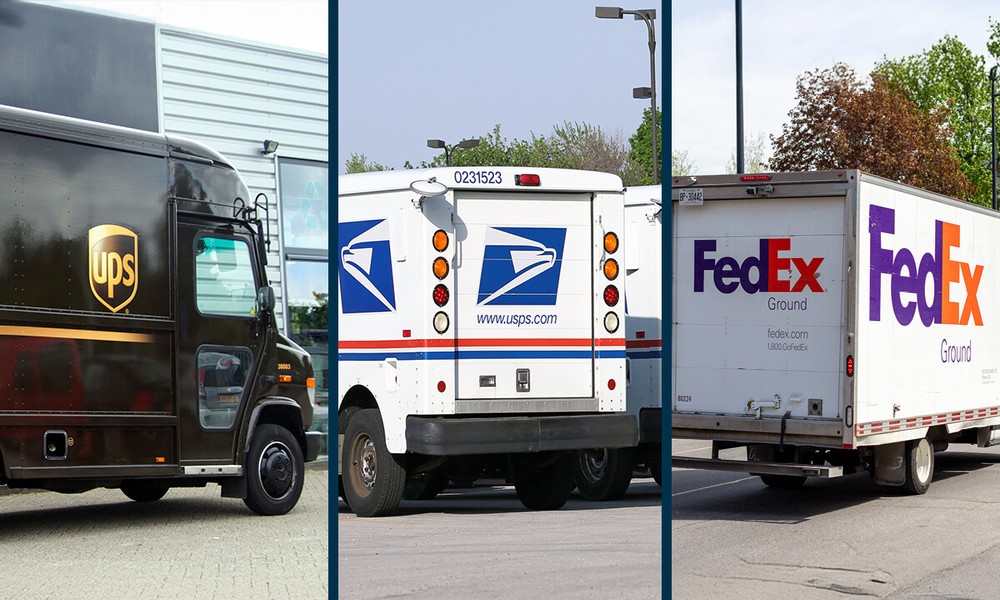

Most people pick a shipping carrier the same way they pick a gas station – whichever one is closest or most familiar. But the right choice actually depends on what you’re shipping, where it’s going, how fast it needs to get there, and what you’re willing to spend. At Newport Beach Mailboxes & More, we ship with FedEx, UPS, and USPS every day, and the honest answer is that no single carrier wins across the board. Each one has situations where it clearly makes more sense than the others.
Here’s how to think through the decision.
USPS: Still the Best for Small, Light, and Rural
The United States Postal Service gets underestimated. For packages under one pound going to a residential address – especially in rural areas or P.O. boxes – USPS First Class Package Service is almost always the cheapest option. No other carrier comes close for lightweight shipments.
Priority Mail Flat Rate boxes are another genuinely useful product. If your item fits in the flat rate box and weighs enough that dimensional weight pricing would hurt you elsewhere, flat rate locks in a predictable cost regardless of weight. The medium flat rate box, for instance, ships coast-to-coast for a fixed price that would be difficult to beat with a comparable UPS or FedEx service.
USPS also delivers on Saturdays at no extra charge as a standard part of service, which neither FedEx nor UPS does by default. And because postal carriers already serve every residential address in the country, delivery reliability to remote zip codes tends to be better than the private carriers.
The tradeoff: USPS tracking is less detailed than FedEx or UPS. Scan events can be sparse, and customer service for lost or delayed packages is slower and harder to navigate. For low-value items, that’s an acceptable risk. For anything expensive or time-sensitive, it’s worth factoring in.
UPS: Built for Weight and Business Shipping
UPS tends to perform best on heavier packages shipped to commercial addresses. Their Ground service is reliable, their dimensional weight pricing is competitive for dense packages, and their network is well-suited to regular business-to-business shipping.
For packages over 10 pounds going to another business, UPS Ground is frequently the most cost-effective option. Their rates for heavier shipments often undercut FedEx Ground, especially if you’re shipping in volume. UPS also has a strong returns infrastructure, which matters if you run any kind of e-commerce operation.
A Note on Dimensional Weight
Both UPS and FedEx calculate shipping costs using dimensional weight, not just actual weight. Dimensional weight is calculated by multiplying length by width by height and dividing by a divisor (currently 139 for both carriers). If your package is large but light – a pillow, a lampshade, a foam item – the dimensional weight will likely exceed the actual weight, and you’ll be billed for the higher number. USPS uses dimensional weight pricing only for Priority Mail packages over one cubic foot, which is why lightweight, bulky items are often cheaper to ship through the post office.
This is one of the calculations we run at our Newport Beach shipping counter before recommending a carrier. It makes a real difference on the final price.
FedEx: Speed and Reliability for Time-Sensitive Shipments
FedEx built its reputation on overnight delivery, and that legacy shows in its express network. For shipments that genuinely need to arrive the next morning, FedEx Priority Overnight is the standard. Their express infrastructure is deep, with multiple daily cutoff times and strong reliability on guaranteed delivery windows.
FedEx also tends to edge out UPS on residential delivery for medium-weight packages in certain lanes, though this varies enough that it’s worth comparing rates for your specific origin and destination zip codes rather than assuming one is always cheaper.
One area where FedEx stands out: shipping to and from international destinations. Their international express network is well-developed, and for time-sensitive cross-border shipments, FedEx International Priority is a strong choice. UPS International is competitive as well, but FedEx tends to have better coverage in parts of Asia and Europe for express timelines.
When the Decision Isn’t Obvious
A lot of shipping decisions fall into the middle ground where the answer depends on variables that shift from shipment to shipment. Package weight, destination, delivery deadline, and whether the recipient is at a residential or commercial address all affect which carrier comes out ahead on price and reliability.
A few scenarios that come up often at the counter:
• Shipping to a P.O. Box: USPS is your only option. FedEx and UPS do not deliver to P.O. Boxes.
• Shipping something fragile and expensive overnight: FedEx Priority Overnight with declared value coverage.
• Shipping a heavy box across the country to a business: Compare UPS Ground and FedEx Ground for that specific route.
• Shipping a lightweight item to a residential address: Run the USPS First Class or Priority rate first before assuming the private carriers are cheaper.
Carrier Insurance and Claims: What You Should Know
All three carriers include a baseline level of coverage at no charge – $100 for UPS and FedEx, and up to $100 for USPS Priority Mail. If your shipment is worth more than that, declared value coverage can be added, though it’s priced differently by each carrier and the claims process varies in speed and ease.
UPS and FedEx handle declared value claims faster in most cases. USPS claims for lost packages can take several weeks to resolve and require documentation that many shippers don’t realize they need to keep. Photograph your package before drop-off and save your receipt – this applies with any carrier, but especially with USPS.
How Newport Beach Mailboxes & More Makes This Easier
Comparing carrier rates across services, weight breaks, and delivery zones is tedious when you’re doing it on your own. We do it at the counter. When you bring a package to Newport Beach Mailboxes & More, we can compare live rates across FedEx, UPS, and USPS for your specific shipment and give you a straight answer on which option makes the most sense given your timeline and budget.
We also handle packing, label printing, and drop-off for all three carriers in a single stop, which matters when you’re trying to get things done without driving to three different locations.
Carrier rates, service guarantees, and dimensional weight divisors do change from year to year, so it’s worth checking directly with each carrier for current pricing or asking us at the counter where we stay on top of the updates.
If you’re shipping something in Newport Beach and want to know the best option for your package, stop in. We’ll pull the rates, walk you through the tradeoffs, and get it out the door.