
The investment casting industry is currently undergoing a massive technical shift. For decades, this process—also known as lost-wax casting—has been the gold standard for creating complex, high-precision metal parts. However, new global demands for efficiency and sustainability are pushing the boundaries of what is possible. Manufacturers are now looking toward digital integration and advanced materials to stay competitive. These changes are not just small adjustments; they represent a fundamental evolution in how metal components are designed and produced for critical sectors like aerospace and medical technology.
One of the most significant trends is the adoption of 3D printing for pattern creation. Traditionally, creating a wax mold required expensive and time-consuming hard tooling. Now, engineers can print wax or polymer patterns directly from digital files. This removes the need for costly metal dies during the prototyping phase. By using additive manufacturing, foundries can produce complex geometries that were previously impossible to cast. This flexibility allows for faster design iterations and significantly reduces the time it takes to bring a new product to market.
Digital Twins and Process Simulation
Digital transformation is playing a vital role in modernizing the foundry floor. The use of “Digital Twins”—virtual replicas of physical parts and processes—allows engineers to predict how molten metal will behave. By simulating the pouring and cooling stages, technicians can identify potential defects like air bubbles or shrinkage before a single drop of metal is cast. This predictive capability saves an enormous amount of material and energy. It ensures that the first physical part produced is as close to perfection as possible, reducing the need for expensive rework.
As these digital tools become more accessible, the industry is seeing a move toward “Smart Foundries.” In these environments, sensors monitor everything from shell temperature to humidity levels in the wax room. This data is fed into central systems to maintain the highest levels of consistency. Companies that embrace these technologies, such as those working with Texmo Blank, are able to provide much tighter tolerances than were possible ten years ago. This data-driven approach is essential for meeting the strict safety standards required in the modern industrial landscape.
Advances in Sustainable Alloys
Sustainability is no longer an optional goal; it is a primary driver for innovation in investment casting. The industry is actively searching for ways to reduce its carbon footprint. This includes recycling ceramic shell materials and implementing closed-loop wax recovery systems. Furthermore, there is a growing interest in new, lightweight alloys that offer the same strength as traditional steel but at a fraction of the weight. These materials are particularly important for the automotive and aerospace sectors, where reducing weight directly leads to lower fuel consumption and emissions.
In addition to lightweighting, foundries are experimenting with “superalloys” that can withstand extreme temperatures. These materials are crucial for the next generation of jet engines and clean energy turbines. Mastering the casting of these complex metals requires precise control over the cooling process to manage the grain structure of the metal. As environmental regulations become stricter, the ability to cast high-performance, eco-friendly materials will separate the leaders from the rest of the industry. The focus is shifting toward doing more with less material and less energy.
Automation and Robotic Shelling
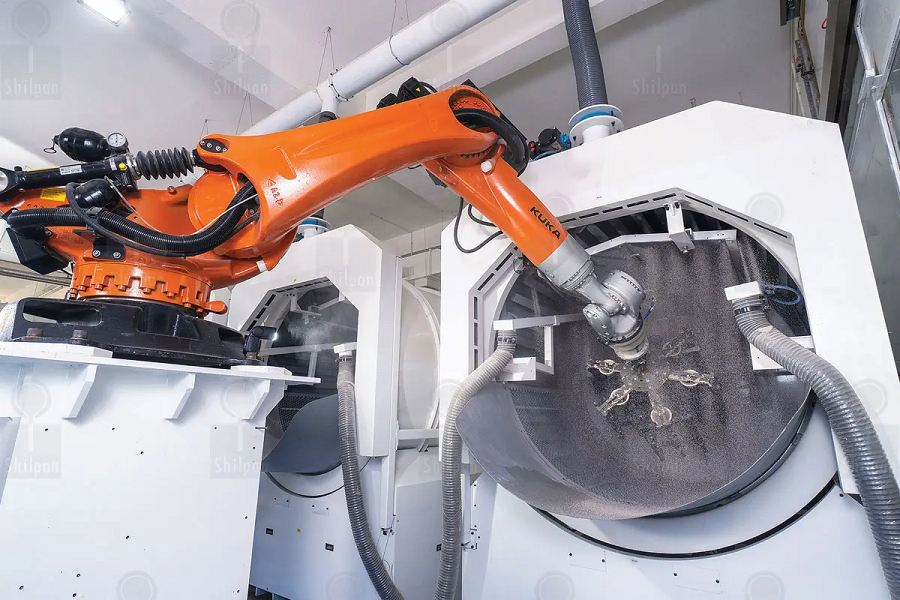
Automation is solving many of the traditional labor challenges faced by the casting industry. The process of “shelling”—where the wax pattern is dipped into a ceramic slurry—is physically demanding and requires extreme consistency. Robotic arms are now commonly used to perform these repetitive tasks. Robots can ensure that every layer of the ceramic shell is applied with the exact same thickness and drying time. This mechanical precision leads to fewer cracked molds and a much higher yield of usable parts at the end of the production line.
Beyond the shelling room, automation is also improving the finishing stages of casting. Removing the ceramic shell and cutting parts away from the “tree” can be dangerous for human workers. High-speed robotic saws and automated grinding stations now handle these tasks with incredible speed and safety. By removing human error from the finishing process, foundries can guarantee a more uniform surface finish. This level of automation allows facilities to run around the clock, meeting the increasing global demand for high-precision components without sacrificing quality.
The Rise of Hybrid Manufacturing
The future of the industry likely lies in a hybrid approach that combines investment casting with other advanced techniques. For example, some manufacturers are now using 3D printing to add complex features onto a standard cast base. This allows for the mass production benefits of casting while still offering the customization of additive manufacturing. Hybrid techniques help bridge the gap between low-volume specialty parts and high-volume industrial production. It provides a “best of both worlds” scenario for engineers looking for specific mechanical properties.
Finally, the global supply chain is becoming more localized and transparent. Customers now demand to know exactly where their metal comes from and how it was processed. Blockchain technology is even being explored to track the “pedigree” of critical parts from the raw ingot to the final machined component. This transparency builds trust and ensures that ethical and environmental standards are met throughout the entire lifecycle. As these trends continue to converge, the investment casting industry will remain a cornerstone of modern manufacturing, proving that an ancient process can still be at the cutting edge of technology.